Guide
Retirement and jubilee bonuses in the Czech Republic: how common they are, how much they pay and how to measure the liability
In brief
The Czech Labour Code permits retirement bonuses and jubilee bonuses (§ 224(2)) but does not create an entitlement to them; the entitlement can be created, for example, by a collective agreement or an internal rule. According to the IPP 2025 survey, 60.0 % of 1,239 business-sector collective agreements include a bonus on the first termination of employment after becoming entitled to an old-age pension (or after the award of an invalidity pension for third-degree invalidity), 58.8 % a bonus on a work anniversary and 50.3 % a bonus on reaching 50 years of age. The average retirement bonus rises with length of service, from CZK 6,206 (up to 5 years) to CZK 20,973 (over 40 years). Under interpretation NÚR I-52 (for accounting under Czech regulations) and under IAS 19 (for financial statements under IFRS), the liability is recognised gradually over the period in which the employee works.
- Labour Code
- § 224(2): an option, not an entitlement
- Retirement bonus
- in 60.0 % of 1,239 collective agreements (IPP 2025, business sector)
- Its average amount
- CZK 6,206 to 20,973 by length of service
- Measurement
- NÚR I-52 and IAS 19
On this page
This is an English translation of the Czech guide Odměna při odchodu do důchodu a jubilejní odměny. Quotations from Czech sources are our translation; IAS 19 is quoted from its official English text.
The Labour Code permits the bonus but creates no entitlement
Under the Labour Code (Act No. 262/2006 Coll., version from 29 August 2026), the employer “may grant the employee a bonus, in particular (a) on a life or work jubilee and on the first termination of employment after the award of an invalidity pension for third-degree invalidity or after becoming entitled to an old-age pension” (§ 224(2)). This is an option, not an obligation: the Czech Labour Code has no mandatory severance payment on retirement.
An entitlement to a retirement bonus or a jubilee bonus can be created for the employee, for example, by a collective agreement or an internal rule. “A collective agreement may regulate the rights of employees in employment relationships” (§ 23(1)). By an internal rule, the employer may set employees’ rights more favourably than the Labour Code does, and the internal rule is binding on the employer (§ 305(1) and (3)). Interpretation NÚR I-52 understands an employee benefit as one “to which the employee is entitled under a legal regulation, a collective agreement, an internal rule or a binding promise of the employer, and which the employer can no longer decide of its own will not to provide” (point 4).
Severance pay on retirement
Severance pay (odstupné) under § 67 is due to an employee whose employment the employer terminates by notice for the reasons in § 52(a) to (c) (closure or relocation of the employer or part of it, redundancy) or in § 52(e) (reaching the maximum permissible exposure), or by agreement for the same reasons. Retirement is not one of these reasons.
How often collective agreements provide them
The regular annual survey of wage and working conditions agreed in collective agreements (IPP 2025) processed selected data from 1,660 collective agreements, of which 1,239 were from the business sector and 421 from the public service and administration. The following data are from the business-sector tables; the share is calculated from 1,239 agreements.
| Bonus (name of the IPP 2025 table) | Share of agreements | Number of agreements | Table |
|---|---|---|---|
| First termination of employment after the award of an invalidity pension for third-degree invalidity or after becoming entitled to an old-age pension | 60.0 % | 743 | A14a |
| Work anniversary | 58.8 % | 728 | A12a |
| Life anniversary: reaching 50 years of age | 50.3 % | 623 | A13a |
Work anniversary and years worked
IPP describes work anniversary bonuses as bonuses “paid to employees for loyalty to the company, graded by length of employment with the same employer”. Interpretation NÚR I-52 lists “jubilees, completion of a certain number of years of work” among its examples of long-term employee benefits (point 14).
Life jubilee bonus
The Labour Code mentions a bonus on a life jubilee in § 224(2)(a) but does not set the age of the jubilee. IPP tracks the bonus on reaching 50 years of age (table A13a), also graded by length of employment with the same employer.
How much they pay: average amounts by length of service
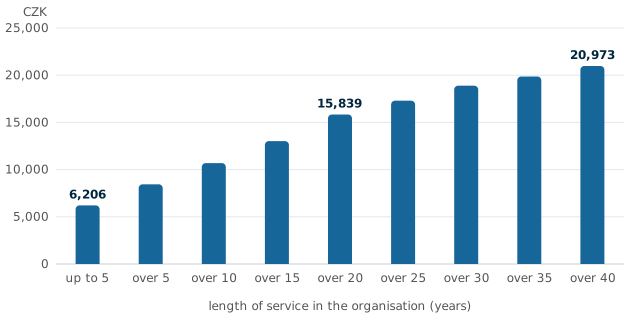
Average amounts in CZK by length of service in the organisation. Each figure is the average bonus in the agreements that provide it for that length of service.
| Length of service in the organisation | Retirement / third-degree invalidity (A14a) | Work anniversary (A12a) | Age 50 (A13a) |
|---|---|---|---|
| up to 5 years | 6,206 | 3,728 | 4,545 |
| over 5 years | 8,441 | 4,385 | 5,065 |
| over 10 years | 10,684 | 7,010 | 6,315 |
| over 15 years | 13,023 | 9,067 | 7,297 |
| over 20 years | 15,839 | 11,200 | 8,293 |
| over 25 years | 17,302 | 12,939 | 8,982 |
| over 30 years | 18,887 | 14,988 | – |
| over 35 years | 19,861 | 16,394 | – |
| over 40 years | 20,973 | 18,218 | – |
Table A13a (age 50) ends with the category “over 25 years”.
Provision for employee bonuses: how to measure the liability
For accounting under Czech regulations, the presentation of employee benefits is dealt with by interpretation NÚR I-52; for financial statements under IFRS, by IAS 19.
Under Czech accounting regulations: interpretation NÚR I-52
The interpretation “is not a legally binding opinion; it only expresses the professional opinion of the National Accounting Council”. It states:
- The expense arises in the period in which the employee performed the work that gives rise to the entitlement (point 6); long-term benefits, such as jubilees, are recognised gradually over the whole period of work (points 14 and 15).
- The measurement must take into account all known facts; it is appropriate to use mathematical and statistical methods as well and to consider using valuation methods based on discounted cash flows (point 8).
- Depending on the nature of the liability, the accounting entity decides whether to present it as an ordinary liability, an estimated item or a provision (point 9).
Details are in the guide Czech Republic: NÚR I-52.
Under IAS 19
Accounting entities that prepare their financial statements under IFRS determine the present value of the obligation for both types of bonus using the projected unit credit method (paragraph 67, for other long-term employee benefits together with paragraph 155), but classify them in different categories:
| Retirement bonus | Jubilee bonuses (work and life anniversaries) | |
|---|---|---|
| Category under IAS 19 | post-employment benefits (paragraphs 5 and 8) | other long-term employee benefits (paragraphs 5, 8 and 153) |
| Service cost and net interest | in profit or loss (paragraph 120) | in profit or loss (paragraph 156) |
| Remeasurements (comprise actuarial gains and losses, paragraph 127) | in other comprehensive income (paragraph 120) | in profit or loss (paragraph 156) |
Jubilee bonuses are other long-term employee benefits “if not expected to be settled wholly before twelve months after the end of the annual reporting period in which the employees render the related service” (paragraph 153).
Who uses IFRS is explained in the guide IAS 19 in the Czech Republic.
Selected official data on Czech government bond yields, wages, inflation and mortality are on the page Aktuárské předpoklady (in Czech).
Sources
- IPP 2025: regular annual survey of wage and working conditions agreed in collective agreements: publication (PDF), description of the published tables, and tables A12a, A13a and A14a (XLSX file) (in Czech)
- Act No. 262/2006 Coll., Labour Code, § 23(1), § 52, § 67, § 224(2) and § 305 (e-Sbírka, in Czech, version from 29 August 2026; the version from 1 January 2027 does not change these provisions)
- National Accounting Council: Interpretation I-52 Zaměstnanecké požitky (PDF) (in Czech)
- IAS 19 Employee Benefits in Commission Regulation (EU) 2023/1803, paragraphs 5, 8, 67, 120, 127, 153, 155 and 156